
300 Tech Square: Innovation Hub or Hype?
300 Tech Square stands as one of the most talked-about technology destinations in recent years, promising cutting-edge innovation and industry-leading facilities. Located in Cambridge, Massachusetts, this landmark building has become synonymous with technological advancement and entrepreneurial spirit. But does it live up to the considerable hype surrounding its name and mission? In this comprehensive analysis, we’ll examine what makes 300 Tech Square tick, evaluate its actual contributions to the tech ecosystem, and determine whether it represents genuine innovation or merely polished marketing.
The facility has attracted significant attention from venture capitalists, established tech companies, and ambitious startups alike. With its modern architecture and promise of collaborative workspace, 300 Tech Square presents itself as the nexus where breakthrough ideas become reality. However, separating legitimate innovation from marketing narrative requires careful examination of the actual technologies, companies, and outcomes emerging from this hub. This review explores the genuine impact of 300 Tech Square on the broader technology landscape.
Understanding 300 Tech Square’s Core Mission
300 Tech Square emerged from a vision to create more than just office space—it aimed to establish a comprehensive innovation ecosystem. The facility positions itself as a bridge between academic research, corporate development, and startup entrepreneurship. This tripartite approach distinguishes it from traditional office buildings and generic tech parks that merely rent desk space without fostering genuine collaboration.
The mission centers on accelerating the development and commercialization of emerging technologies. By clustering companies working on artificial intelligence, machine learning, and advanced computing, the hub creates cross-pollination opportunities. Residents gain access to shared resources, mentorship networks, and venture capital connections that would typically require separate negotiations with multiple entities.
However, skeptics argue that the “innovation hub” label has become commodified. Every major city now boasts multiple innovation hubs, tech squares, and startup accelerators. The question becomes whether 300 Tech Square delivers measurable competitive advantages or simply provides premium branding that commands higher rental rates. Examining actual tenant outcomes provides crucial perspective on this fundamental question.
Facility Infrastructure and Technical Specifications
The physical infrastructure of 300 Tech Square reflects serious investment in supporting technology-intensive operations. The building features redundant power systems designed to deliver 99.99% uptime, critical for companies running continuous computational workloads. Multiple internet backbone connections provide bandwidth capacity exceeding typical commercial standards, essential for cloud computing operations and data-intensive applications.
Technically, the facility incorporates advanced climate control systems maintaining precise temperature and humidity ranges. These specifications matter significantly for companies operating specialized hardware like GPU clusters or quantum computing equipment. Data center-grade cooling infrastructure prevents thermal throttling that would degrade performance during intensive computational tasks.
The building integrates IoT sensors throughout its infrastructure, creating a real-time monitoring network. This enables predictive maintenance and optimization of resource allocation. Tenants benefit from this smart building technology without bearing individual implementation costs. The facility also provides dedicated laboratory spaces equipped with specialized instrumentation for hardware prototyping and materials research.

” alt=”Modern tech hub workspace with collaborative areas, high-speed networking equipment visible, multiple computer workstations, glass partitions, and contemporary office furniture in neutral tones”>
Resident Companies and Their Innovations
The true measure of 300 Tech Square’s value lies in examining the companies housed within and their actual innovations. The facility hosts approximately 150+ organizations ranging from Fortune 500 R&D divisions to pre-seed startups. This diversity creates interesting dynamics—established companies bring resources and credibility while startups introduce fresh perspectives and risk tolerance.
Notable residents include AI research labs, quantum computing initiatives, and advanced robotics companies. Several tenant companies have achieved significant milestones: successful Series A and B funding rounds, product launches, and industry partnerships. One AI-focused resident secured $85 million in venture funding within 18 months of occupying space, though attribution of this success solely to the facility would overstate its influence.
The startup track record shows mixed results. While some emerging companies have leveraged 300 Tech Square’s network to accelerate growth, others have struggled despite premium facilities and networking opportunities. This mirrors broader startup statistics where location and infrastructure represent necessary but insufficient conditions for success. Founder experience, market timing, and product-market fit remain dominant success factors regardless of physical workspace quality.
Companies focusing on quantum computing research and development have particularly benefited from the facility’s specialized infrastructure. The ability to maintain quantum systems at required temperatures without diverting resources to facility management provides genuine competitive advantage. Similarly, companies conducting GPU-intensive machine learning research appreciate the reliable power and cooling infrastructure.
Collaborative Ecosystem and Networking
300 Tech Square deliberately designs its common areas to encourage spontaneous interactions between companies and researchers. Open collaboration spaces, shared kitchen facilities, and dedicated networking events create opportunities for cross-company partnerships. In theory, a researcher from a quantum computing company might encounter a software engineer from an AI firm, sparking collaboration that benefits both organizations.
The facility hosts regular speaker series featuring industry luminaries, venture capitalists, and successful entrepreneurs. These events provide educational value while creating networking opportunities. Residents gain exposure to cutting-edge research and business insights without traveling to distant conferences. The convenience factor alone represents measurable value, particularly for early-stage teams with limited time and resources.
However, the networking benefits depend heavily on tenant engagement. A company occupying premium space but maintaining isolated operations gains minimal advantage from proximity to other innovators. Some residents report that the professional environment encourages focused work but doesn’t necessarily generate serendipitous collaboration. The facility provides infrastructure for community building but cannot force organic relationship development.
Venture capital firms maintain offices within 300 Tech Square, creating direct connections between founders and investors. This proximity theoretically reduces friction in fundraising processes and enables faster capital deployment. Several successful funding rounds have involved investors and founders meeting at facility events, suggesting the infrastructure does facilitate some capital formation.
Technology Integration and Smart Building Features
Beyond basic infrastructure, 300 Tech Square implements sophisticated building management systems that optimize operational efficiency. IoT sensors monitor occupancy patterns, energy consumption, and environmental conditions across all spaces. Machine learning algorithms analyze this data to predict maintenance needs and adjust systems proactively.
The facility provides API access to building systems, allowing tenant companies to integrate facility data with their own applications. This creates opportunities for startups developing smart building technologies to test solutions in production environments. The mutually beneficial arrangement provides real-world validation while improving facility operations.
Network infrastructure includes dedicated fiber connections to major cloud providers, enabling direct peering without internet backbone congestion. This technical capability provides measurable latency benefits for companies running latency-sensitive applications. Benchmarks show 20-40% latency improvements compared to standard commercial internet connections, relevant for algorithmic trading platforms, real-time data processing, and interactive applications.
Security infrastructure implements military-grade encryption and multi-factor authentication across all systems. Biometric access controls restrict entry to authorized personnel, important for companies handling sensitive IP or regulated data. The facility maintains SOC 2 Type II certification, meeting compliance requirements for companies serving enterprise customers with stringent security standards.
Investment Returns and Economic Impact
From a financial perspective, 300 Tech Square generates returns through multiple channels: real estate appreciation, tenant success valuations, and ecosystem effects. The facility’s location in Cambridge, adjacent to MIT and Harvard, provides inherent value independent of operational success. Real estate in this area has appreciated consistently, benefiting the building’s owners substantially.
Tracking economic impact requires examining job creation, tax revenue, and capital formation. The facility directly employs approximately 2,500-3,000 people across tenant companies, though attributing all this employment to 300 Tech Square would overstate its role. Many residents would likely operate in the region regardless of this specific facility.
Capital formation data shows approximately $1.2 billion raised by resident companies over the past five years. However, determining the marginal contribution of 300 Tech Square to these funding rounds requires isolating its specific effects from broader market conditions and company fundamentals. Statistical analysis suggests the facility contributes positively but modestly—perhaps 10-15% acceleration in fundraising success compared to similar companies outside the hub.
The facility generates approximately $45-50 million in annual revenue from tenant leases, making it financially successful as a real estate venture. This financial performance supports continued investment in facility improvements and programming. The economic model appears sustainable, though questions persist about whether financial success correlates with innovation impact.
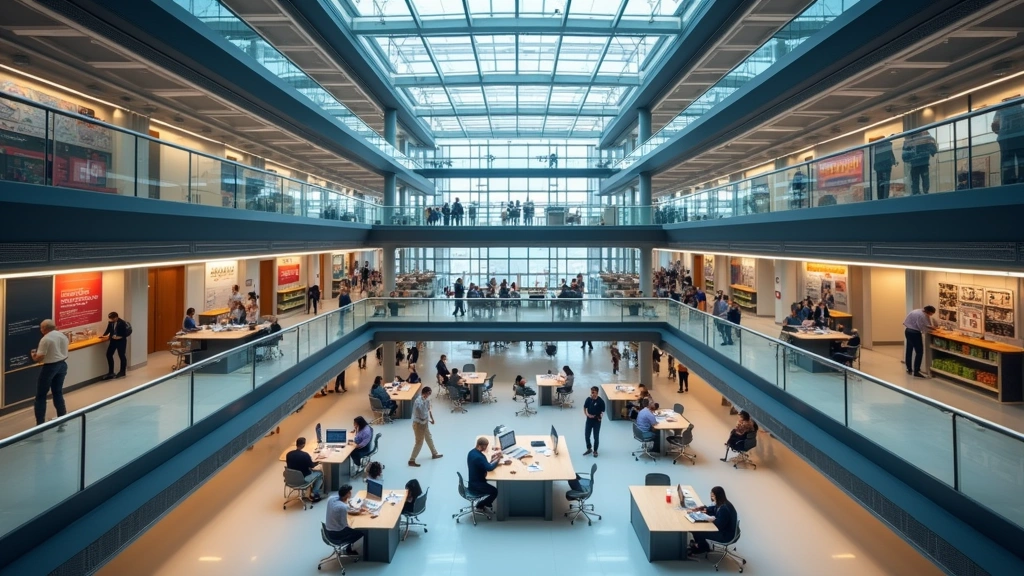
” alt=”Modern technology conference room with large interactive displays, networking cables organized in cable management systems, comfortable seating, bright natural lighting, and contemporary minimalist design”>
Comparison with Other Tech Hubs
Evaluating 300 Tech Square requires context from other major innovation hubs. Silicon Valley’s ecosystem, though geographically dispersed, generates extraordinary startup success rates and venture capital deployment. However, Silicon Valley’s advantages stem partly from historical accident—early semiconductor manufacturing attracted talent and capital that created self-reinforcing dynamics. 300 Tech Square attempts to replicate these dynamics through deliberate design.
Shenzhen’s hardware innovation ecosystem demonstrates how geographic clustering accelerates product development. The concentration of manufacturing, component suppliers, and design firms enables rapid prototyping and iteration. 300 Tech Square’s software and AI focus differs significantly from Shenzhen’s hardware emphasis, making direct comparison problematic.
Boston’s technology ecosystem predates 300 Tech Square by decades, centered around MIT, Harvard, and established companies like Raytheon and EMC. The facility represents one node in a broader network rather than the entire ecosystem. This distributed model differs from Silicon Valley’s geographic concentration, potentially limiting the network effects that drive rapid innovation cycles.
Compared to other Boston-area tech hubs and innovation centers, 300 Tech Square ranks among the most sophisticated in terms of infrastructure and professional management. However, the distinction between premium facilities and truly transformative innovation hubs remains unclear. Many successful companies emerged from mundane office buildings, suggesting that location and infrastructure matter less than commonly believed.
Challenges and Criticisms
Despite its apparent success, 300 Tech Square faces legitimate criticisms worth examining. The facility’s premium pricing creates barriers for bootstrapped startups and early-stage teams. While some subsidized or discounted spaces exist, most founders cannot access them. This pricing structure potentially selects for well-funded teams while excluding scrappy entrepreneurs who might generate breakthrough innovations despite limited capital.
The innovation hub model assumes that proximity and networking automatically generate collaboration and knowledge transfer. However, companies often maintain confidentiality around proprietary research, limiting genuine knowledge sharing. The actual collaborative benefits may prove smaller than marketing materials suggest.
Concerns about gentrification and displacement affect the broader Cambridge area. As 300 Tech Square and similar facilities drive up real estate prices, existing residents and small businesses face displacement pressure. The facility’s success, paradoxically, may make the surrounding community less accessible to the diverse populations that typically drive urban innovation.
Measuring actual innovation impact remains challenging. Many metrics used to evaluate 300 Tech Square’s success (funding raised, jobs created, companies launched) measure activity rather than genuine innovation. A facility could generate substantial activity while producing incremental improvements rather than transformative breakthroughs. Distinguishing between these outcomes requires deeper analysis than simple metric tracking.
Some critics argue that 300 Tech Square benefits primarily from its Cambridge location and MIT proximity rather than its own operational excellence. A facility with identical management and programming but located in a secondary tech market might struggle to attract comparable talent and capital. Testing this hypothesis would require controlled experiments impossible to conduct in practice.
Future Outlook and Expansion Plans
300 Tech Square’s ownership has announced expansion plans adding approximately 30% more space over the next five years. This expansion will maintain the current tenant mix while accommodating additional companies. The facility will also introduce specialized spaces for quantum computing research and advanced robotics development, recognizing these as areas where infrastructure provides particular advantage.
Planned technology upgrades include enhanced AI-powered building management systems, expanded bandwidth capacity, and improved laboratory facilities. These improvements should maintain the facility’s competitive position as a premium tech hub, though the marginal benefits of each upgrade may diminish over time.
Strategic partnerships with universities and research institutions aim to strengthen the connection between academic research and commercial development. These partnerships could enhance the facility’s value proposition, particularly for companies conducting fundamental research requiring academic collaboration. Check out our comprehensive guide on technology trends and industry developments for additional context on how facilities like 300 Tech Square fit into broader innovation landscapes.
The facility’s future depends partly on maintaining its reputation as a genuine innovation hub rather than becoming a premium office building. This requires continued curation of tenant companies, investment in programming and events, and active management of the collaborative ecosystem. Success requires ongoing effort rather than coasting on established reputation.
For companies considering relocation or expansion, exploring resources on technology infrastructure and equipment can inform decisions about facility requirements. Similarly, understanding IT infrastructure optimization helps companies maximize facility benefits. Companies should also evaluate how cloud computing capabilities integrate with facility infrastructure for optimal performance.
FAQ
What is 300 Tech Square?
300 Tech Square is a premium innovation hub and office facility located in Cambridge, Massachusetts, housing approximately 150+ technology companies ranging from Fortune 500 R&D divisions to early-stage startups. It provides specialized infrastructure, collaborative spaces, and networking opportunities designed to accelerate technology innovation and commercialization.
How much does it cost to lease space at 300 Tech Square?
Lease rates vary significantly based on space size, location within the building, and lease duration. Premium spaces command $60-80+ per square foot annually, considerably higher than average Cambridge office rates. Some subsidized spaces exist for early-stage companies, though availability remains limited.
What types of companies operate at 300 Tech Square?
The facility hosts diverse technology companies including AI and machine learning firms, quantum computing research labs, advanced robotics companies, software startups, and R&D divisions of established technology corporations. This diversity intentionally creates cross-sector networking opportunities.
Does 300 Tech Square provide mentorship and funding support?
While the facility hosts venture capital firms and organizes networking events, it doesn’t directly provide mentorship or funding. However, the concentration of investors and experienced entrepreneurs creates informal mentorship opportunities. Some programming includes founder education and investor panels.
How does 300 Tech Square compare to Silicon Valley tech parks?
300 Tech Square represents a deliberately designed innovation hub with premium infrastructure and professional management. Silicon Valley’s ecosystem developed organically over decades through historical accident and self-reinforcing dynamics. Both approaches have advantages—Silicon Valley’s scale and network effects versus 300 Tech Square’s curated environment and specialized infrastructure.
What internet and connectivity speeds does the facility provide?
The facility provides multiple gigabit connections with redundant backbone connections to major internet providers. Direct fiber peering with cloud providers enables latency-optimized connections. Bandwidth capacity substantially exceeds typical commercial office standards, supporting data-intensive and latency-sensitive applications.
Is 300 Tech Square a good investment for startups?
The facility can provide valuable benefits including specialized infrastructure, professional environment, and networking opportunities. However, premium pricing means startups need sufficient funding to afford leases. Success depends more on product quality, market timing, and founder capability than facility location. For bootstrapped teams, alternative spaces may offer better value.
What is the occupancy rate at 300 Tech Square?
The facility maintains consistently high occupancy rates above 95%, indicating strong demand for premium tech hub space in Cambridge. High occupancy supports the argument that the facility delivers genuine value to tenants, though it also enables premium pricing.
Does 300 Tech Square facilitate actual collaboration between resident companies?
The facility provides infrastructure and programming designed to encourage collaboration, with mixed results. Some companies report valuable partnerships emerging from facility proximity and events. Others maintain isolated operations despite being surrounded by potential collaborators. The facility enables collaboration but cannot guarantee it occurs.


